Fearful-Avoidant Attached
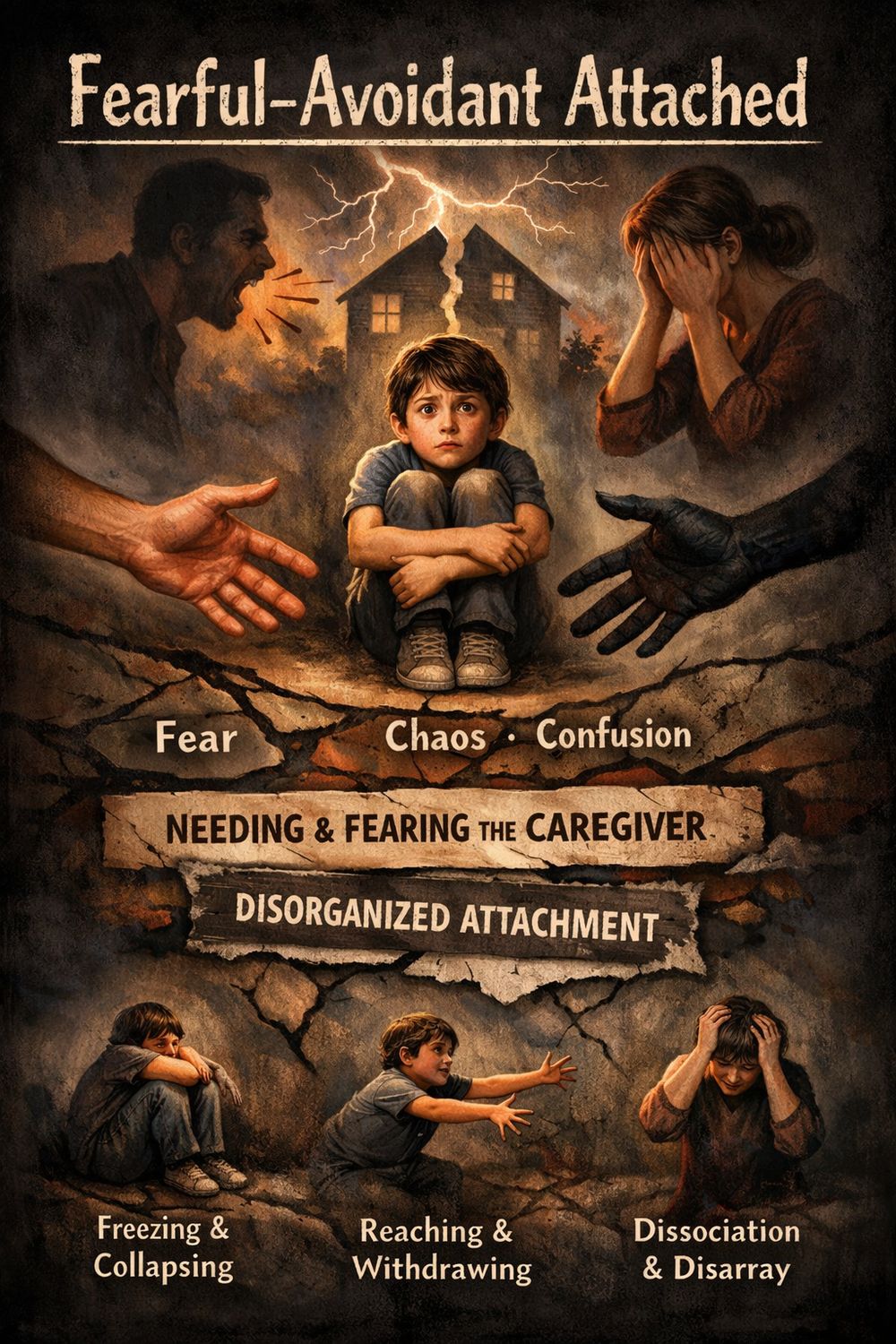
Fearful-Avoidant attached is defined by chaos in the attachment system.
This pattern develops when the original source of safety was also a source of fear, unpredictability, or emotional instability. The child’s nervous system is placed in an impossible position. The caregiver is needed for regulation and survival, but the caregiver also triggers alarm. The system cannot form a coherent strategy for connection because connection itself carries danger.
In childhood research, this breakdown of strategy led to the classification known as disorganized or disoriented attachment. The category was introduced by Mary Main and Judith Solomon after they observed infants in the Strange Situation who did not fit Ambivalent or Avoidant patterns. These children displayed contradictory, freezing, collapsing, or disoriented behaviors when reunited with their caregiver. The problem was not insecurity alone. The problem was the absence of an organized strategy.
Later, Mary Main and Erik Hesse extended this work into adulthood through the Adult Attachment Interview. They identified what they termed unresolved states of mind related to trauma and loss. Adults with unresolved attachment fear often showed lapses in reasoning, dissociation, or sudden disorganization when discussing early attachment experiences. This research connected childhood disorganization with fearful relational functioning in adulthood.
Fearful-Avoidant is therefore not simply high anxiety plus high avoidance.
It is the collapse of a stable attachment strategy due to early relational chaos.
- Ambivalent attachment is organized around hyperactivation.
- Dismissive attachment is organized around deactivation.
- Fearful-Avoidant attachment is organized around instability.
How Fearful-Avoidant Attachment Affects the Nervous System
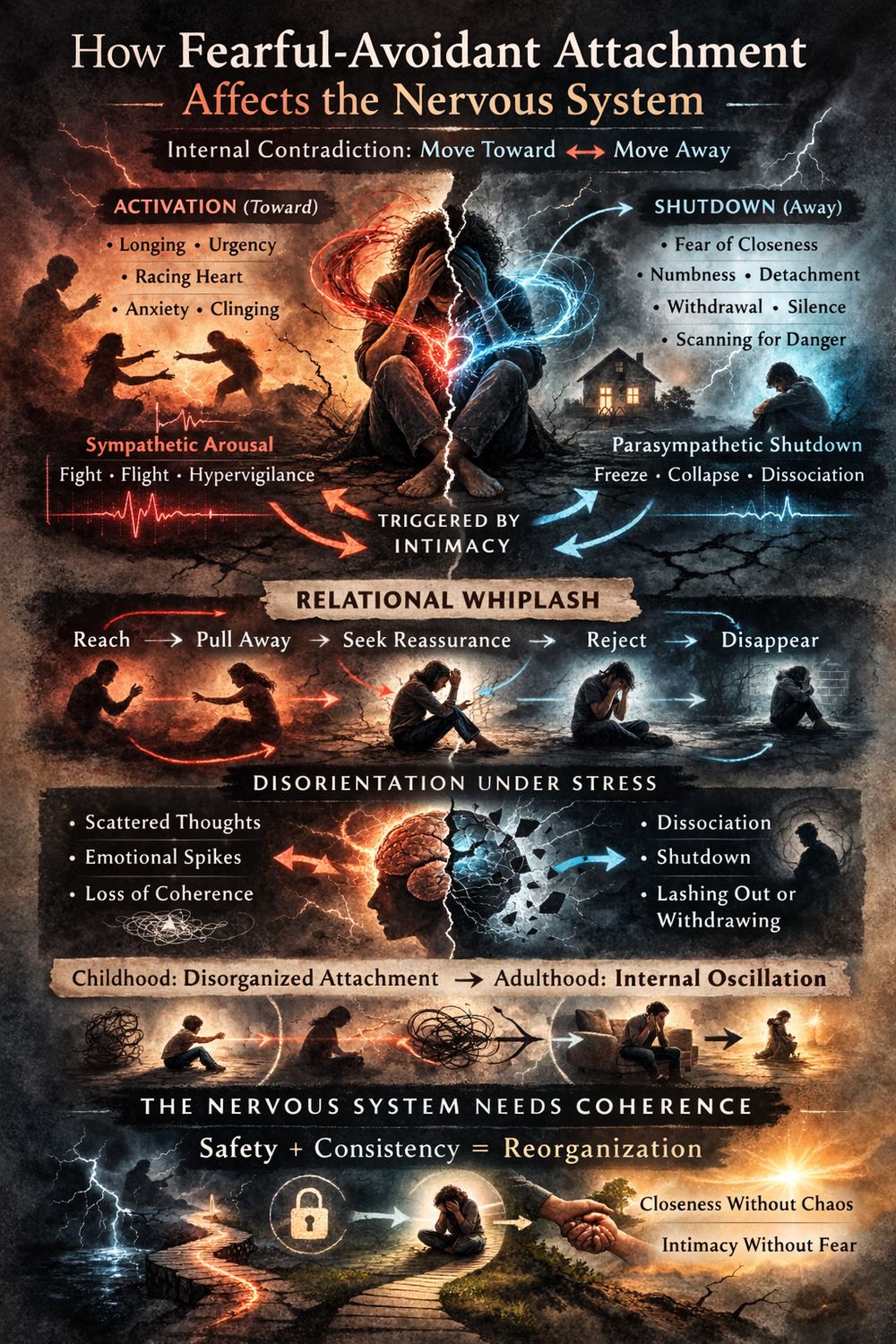
The defining feature is internal contradiction. The nervous system receives two opposing signals at the same time: move toward and move away.
Example 1: Simultaneous Activation and Shutdown
When intimacy increases, the attachment system activates. There may be longing, urgency, heightened awareness of the partner’s cues, and emotional intensity. At the same time, closeness triggers fear. The body can spike into sympathetic arousal, racing heart, tight chest, agitation, and scanning for threat.
But because closeness itself is coded as unsafe, the system may abruptly shift into parasympathetic shutdown. The person can go numb, detach, lose words, or feel suddenly disconnected.
This creates relational whiplash:
- Reaching out, then pulling away
- Wanting reassurance, then rejecting it
- Opening up, then disappearing
The chaos is not dramatic behavior. It is conflicting neural activation without integration.
In childhood, Main and Solomon observed similar contradictions in disorganized infants who approached the caregiver and then froze, collapsed, or turned away in confusion. In adulthood, that same unresolved conflict becomes oscillation inside intimate relationships.
Example 2: Disorientation Under Relational Stress
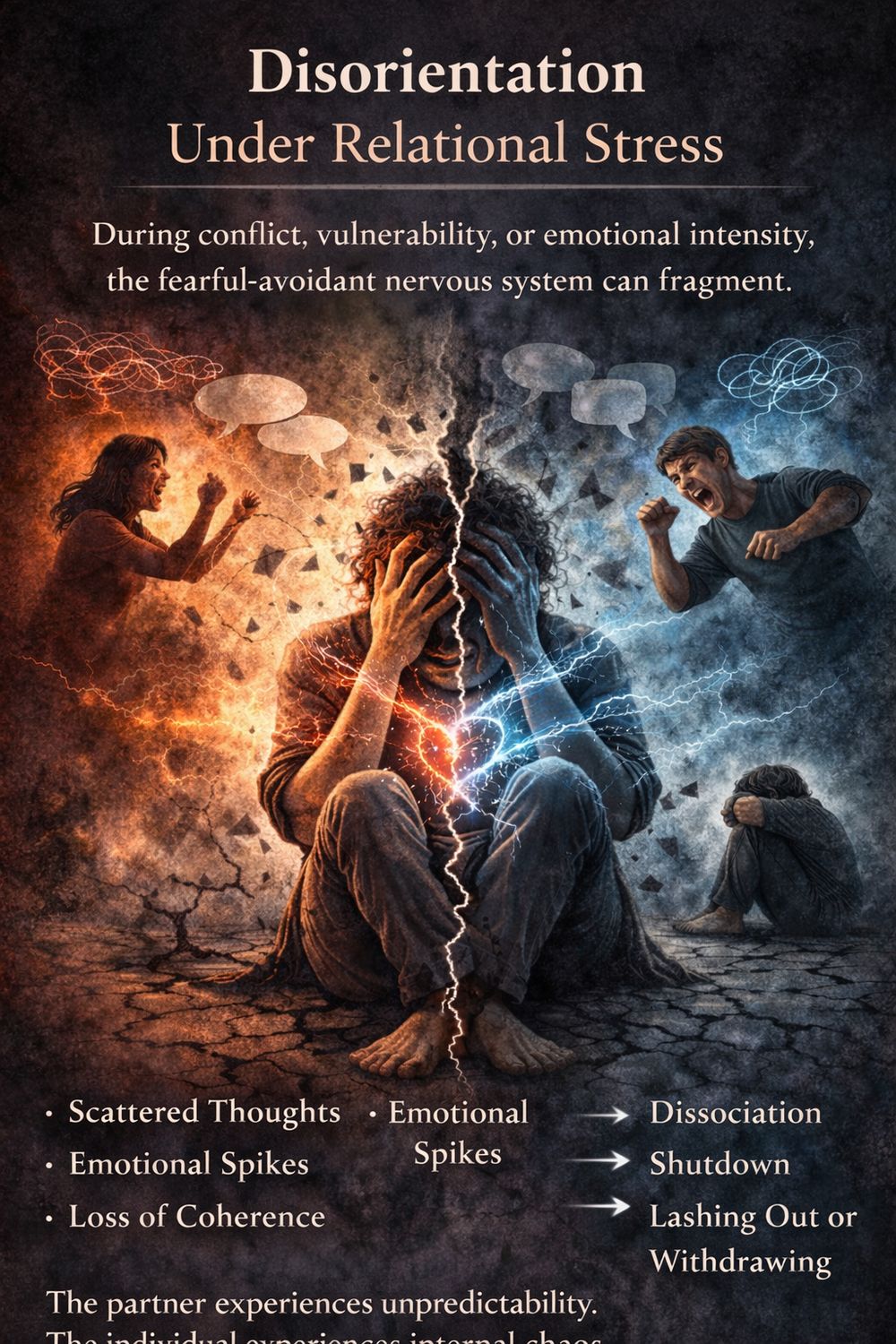
During conflict, vulnerability, or emotional intensity, the fearful-avoidant nervous system can fragment.
Thoughts become scattered.
Emotions spike and then flatten.
Speech loses coherence.
The person may dissociate, shut down, lash out, or abruptly withdraw.
Main and Hesse’s work with the Adult Attachment Interview identified lapses in reasoning and discourse when adults discussed attachment related trauma or loss. These lapses reflected unresolved fear that had not been integrated into a coherent narrative. When similar triggers appear in adult relationships, the nervous system reacts not with a single strategy but with disorganization.
- The partner experiences unpredictability.
- The individual experiences internal chaos.
The Developmental Through Line
A child who grows up in ongoing relational chaos may develop a disorganized attachment pattern. If that chaos is not repaired and the nervous system is not rewired through consistent safety, the disorganization can carry forward into adulthood as fearful-avoidant attachment.
Research does not describe this pathway as automatic or inevitable. Protective relationships and corrective experiences can reorganize the system. But when instability continues, the nervous system adapts by remaining unstable.
Fearful-Avoidant attachment is therefore not a personality flaw.
It is an adaptation to relational environments where safety and danger were fused together.
- The work of healing is the gradual construction of coherence.
- Teaching the nervous system that closeness can be steady.
- That connection does not have to collapse into chaos.
- That intimacy can exist without fear.